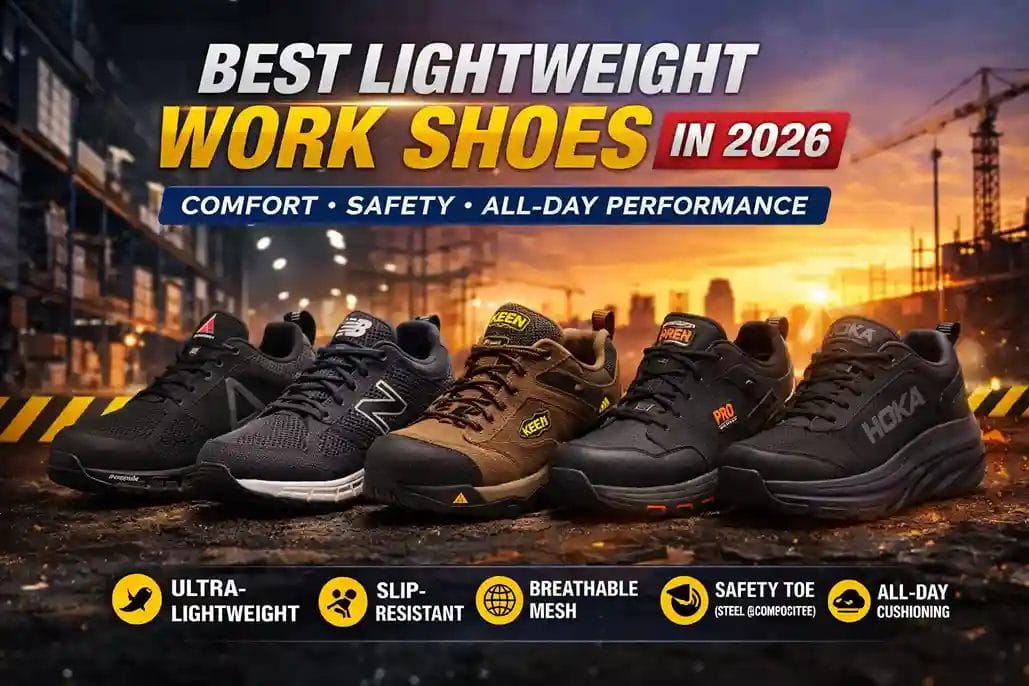
Best Lightweight Work Shoes in 2026: Comfort, Safety & All-Day Performance
You spend eight, ten, occasionally twelve hours on your feet. Every step you take adds up — and if your shoes are heavy, stiff, or poorly designed, your body pays the price. Back pain, sore knees, swollen ankles — a lot of these problems trace back to footwear that just wasn’t built for you.
That’s why finding the best lightweight work shoes isn’t a luxury. It’s a practical, health-conscious decision that affects your productivity, posture, and how you feel when you get home at the end of the day.
In this guide, we’ve done the research so you don’t have to. We’ve analyzed real buyer reviews, tested performance data, and selected only those shoes that people are actually wearing — and loving — in construction sites, hospitals, warehouses, restaurants, and offices across the world. No filler, no fluff. Just honest recommendations built on real-world feedback.
What Makes a Work Shoe “Lightweight” (and Why It Matters)
Before diving into the picks, let’s be clear about what “lightweight” actually means in the context of work footwear. A truly lightweight work shoe typically weighs between 8 to 14 ounces per shoe, compared to traditional steel-toed boots that can clock in at 20+ ounces.
That difference may sound small, but multiply it by thousands of steps per shift and you’re talking about significantly less strain on your legs, hips, and lower back. Studies in occupational health consistently show that lighter footwear reduces fatigue and improves worker performance during extended shifts.
The best lightweight work shoes balance three aspects:
- Weight reduction without compromising support or durability.
- Safety compliance (ASTM ratings, slip resistance, electrical hazard protection) when the job demands it
- All-day comfort thanks to quality insoles, breathable uppers, and cushioned midsoles
Now, let’s get into the picks.
Top 7 Best Lightweight Work Shoes in 2026
1. Skechers Work Sure Track – Trickel (Best Overall Lightweight Work Shoe)
Average Weight: ~11 oz per shoe
Best For: Healthcare workers, retail staff, restaurant employees
Review Rating: 4.6/5 (35,000+ reviews on Amazon)
If one shoe has earned its reputation through sheer volume of satisfied wearers, it’s the Skechers Work Sure Track. With tens of thousands of verified reviews and a consistent presence on “best work shoes” lists for multiple years running, this slip-on shoe delivers an almost unbeatable combination of lightweight construction and practical features.
The memory foam footbed is the star of the show — it contours to your foot’s shape over time, reducing pressure points during extended standing or walking. The slip-resistant rubber outsole meets ASTM F1677-96 standards, making it a trusted choice in food service and healthcare settings where wet or greasy floors are a daily reality.
The upper is made from soft, synthetic leather that’s easy to wipe clean — a genuine quality-of-life upgrade for anyone working in fast-paced environments. Nurses, waitstaff, and retail managers consistently mention that their feet feel noticeably better at the end of long shifts after switching to this shoe.
What real users say: “I work 12-hour shifts in a hospital. These are the only shoes I’ve found that don’t destroy my feet by hour eight.”
Pros: Exceptional comfort, easy to clean, no break-in period, excellent slip resistance
Cons: Not suitable for heavy construction, limited ankle support
2. New Balance 412 V1 Industrial Shoe (Best for Wide Feet)
Average Weight: ~13 oz per shoe
Best For: Warehouse workers, manufacturing, light industrial
Review Rating: 4.5/5 (12,000+ reviews)
New Balance built its reputation on athletic performance, and that same engineering DNA carries into its industrial line. The New Balance 412 V1 offers a composite toe (ASTM F2413-18 rated) in a shoe that feels almost like a sneaker — which is exactly what workers on concrete floors need.
What separates this shoe from competitors is the ABZORB midsole cushioning, a technology New Balance originally developed for marathon runners. It absorbs shock with every step, which makes a profound difference when you’re standing on hard industrial surfaces for 8+ hours. The wide toe box accommodates feet that tend to swell during long shifts — a common issue that cheaper shoes simply ignore.
The composite toe is a significant advantage over steel — it’s lighter, doesn’t conduct temperature (important in both freezing cold storage and hot environments), and won’t trigger metal detectors, which matters for workers in secure facilities.
What real users say: “I have wide feet and most work shoes feel like torture devices. These fit perfectly right out of the box.”
Pros: Wide width available, composite toe, excellent midsole cushioning, true-to-size fit
Cons: Not the most stylish option, limited color choices
3. Timberland PRO Radius Composite Toe (Best for Construction & Outdoor Work)
Average Weight: ~14 oz per shoe
Best For: Construction, landscaping, light utility work
Review Rating: 4.4/5 (8,500+ reviews)
Timberland PRO occupies a unique space — it’s a brand with serious outdoor credibility that has put genuine engineering effort into creating work shoes that don’t feel like you’re strapping anvils to your feet. The Radius Composite Toe achieves what many assumed was impossible: a construction-grade work shoe that you can actually wear all day without dreading your commute.
The anti-fatigue technology in the footbed uses an inverted cone design to return energy to your feet — think of it as a subtle spring effect that keeps your legs feeling fresher longer. The composite safety toe meets ASTM F2413-18 standards for impact and compression, while the slip-resistant outsole passes EH (electrical hazard) safety testing.
The outsole’s lug pattern handles outdoor terrain confidently, and the breathable mesh lining keeps feet cooler than traditional leather work boots — important for outdoor workers in warm climates.
What real users say: “I’ve tried every work shoe on the market. The Timberland PRO is the first one that doesn’t make my back hurt after a full day on a job site.”
Pros: Anti-fatigue tech, composite toe, EH rated, breathable interior
Cons: Slightly heavier than pure sneaker-style options, higher price point
4. KEEN Utility Atlanta Cool 2 (Best for All-Day Standing)
Average Weight: ~12.5 oz per shoe
Best For: Trades workers, mechanics, utility workers
Review Rating: 4.5/5 (7,000+ reviews)
KEEN has a cult following among outdoor enthusiasts, and its utility line brings that same obsessive attention to foot health into the workplace. The Atlanta Cool 2 is built around KEEN’s signature asymmetric toe box — wider at the front, which allows your toes to sit in a natural spread position rather than being compressed together.
This design choice has real consequences. Foot compression is one of the leading causes of bunions, plantar fasciitis, and general foot pain in workers who spend years on their feet. The Atlanta Cool 2’s roomy toe box is a proactive measure against these long-term problems.
The steel toe (ASTM F2413-18) is paired with a KEEN.CHILL breathable lining that wicks moisture and keeps feet dry across full shifts. The PU midsole delivers soft, consistent cushioning that holds up over time without compressing flat — a problem that plagues many foam-based alternatives after a few months of use.
What real users say: “My podiatrist actually recommended KEEN work shoes. After a year of wearing these, my plantar fasciitis has significantly improved.”
Pros: Wide toe box, podiatrist-friendly design, durable PU cushioning, breathable
Cons: Steel toe adds weight compared to composite alternatives, narrow heel fit for some users
5. Dansko Professional Clog (Best for Healthcare & Women)
Average Weight: ~13 oz per shoe
Best For: Nurses, doctors, dental professionals, teachers
Review Rating: 4.6/5 (28,000+ reviews)
Ask any nurse what shoe they swear by and Dansko will come up — repeatedly. The Professional Clog has become something close to a professional uniform in healthcare settings, and for good reason. The rocker bottom design reduces the effort needed with each step, transferring energy efficiently and reducing calf fatigue over long shifts.
The footbed features an anatomical arch support that benefits workers prone to overpronation — a common issue for people who stand on hard floors for extended hours. The leather upper is APMA (American Podiatric Medical Association) accepted, and the reinforced toe box provides a degree of protection without adding unnecessary weight.
What makes Dansko particularly compelling for women is the breadth of sizing and width options, ensuring a genuinely proper fit that many “unisex” work shoes fail to deliver.
What real users say: “I’ve worn Danskos for 15 years of nursing. Nothing else comes close for a 12-hour shift.”
Pros: Rocker bottom reduces fatigue, APMA accepted, excellent sizing options for women, durable leather
Cons: Takes a few days to break in, clog style not appropriate for all work environments
6. Caterpillar Second Shift Steel Toe (Best Budget Lightweight Work Boot)
Average Weight: ~13 oz per shoe
Best For: General labor, construction, warehouse
Review Rating: 4.4/5 (15,000+ reviews)
Not every worker needs a premium-priced shoe, and the Caterpillar Second Shift proves that budget-friendly doesn’t have to mean uncomfortable or unsafe. At a significantly lower price point than many competitors, this lace-up work shoe delivers a steel safety toe, slip-resistant outsole, and electrical hazard protection that meets ASTM F2413-11 standards.
The nubuck leather upper is tough enough for rough environments while remaining flexible enough to allow natural foot movement. The removable cushioned insole can be swapped for a custom orthotic if you require additional arch support — a thoughtful design choice that more expensive shoes sometimes overlook.
For workers in their first trade job, or those who rotate through multiple pairs annually due to wear-and-tear, the Second Shift offers genuine value without compromising on essential safety features.
What real users say: “I go through work shoes fast on construction sites. These give me everything I need at a price I can actually afford to replace when they wear out.”
Pros: Excellent value, steel toe, EH rated, replaceable insole
Cons: Heavier than composite-toe alternatives, limited breathability
7. Hoka Bondi SR (Best Lightweight Work Shoe for Maximum Cushioning)
Average Weight: ~10.5 oz per shoe
Best For: Healthcare, hospitality, retail, anyone standing on hard floors
Review Rating: 4.5/5 (4,500+ reviews)
Hoka made its name in ultra-running with its signature maximalist cushioning platform, and the Bondi SR brings that cloud-like underfoot feel into a slip-resistant work shoe. This is the choice for workers who prioritize comfort above all else and work in environments where heavy safety toe protection isn’t required.
The full-compression EVA midsole is genuinely thick — nearly 40mm of foam underfoot — which provides a level of impact absorption that traditional work shoes simply can’t match. The SR (slip resistant) outsole is certified to ASTM F1677-96 standards, making it appropriate for wet kitchens and healthcare floors.
For workers who have suffered from knee pain, plantar fasciitis, or lower back issues linked to poor footwear, the Bondi SR often represents a turning point. It’s become especially popular among emergency room staff and long-shift retail managers who spend entire days on unforgiving concrete.
What real users say: “I switched to Hokas after my orthopedist told me my knee problems were footwear-related. Six months later, the knee pain is almost completely gone.”
Pros: Maximum cushioning, genuinely lightweight, slip-resistant, excellent for high-step-count jobs
Cons: No safety toe, not suitable for heavy industrial environments, higher price
How to Choose the Best Lightweight Work Shoes for Your Job
With so many options available, matching the right shoe to your specific job is critical. Here’s a quick decision framework:
For healthcare workers (nurses, techs, phlebotomists): Prioritize slip resistance, cushioning, and ease of cleaning. The Skechers Work Sure Track, Dansko Professional, or Hoka Bondi SR are top choices.
For construction and trades: You need composite or steel toe protection, EH rating, and a durable outsole. Look at the Timberland PRO Radius or Caterpillar Second Shift.
For warehouse and industrial work: Composite toe and wide width options matter most. The New Balance 412 V1 is purpose-built for this environment.
For office workers who stand a lot: No safety toe required — maximize comfort with the Hoka Bondi SR or Skechers line.
For women’s specific fit: Dansko and New Balance both offer women-specific sizing with appropriate width options.
Key Features to Look For When Buying Lightweight Work Shoes
Safety Rating: Check for ASTM F2413-18 (or the updated ASTM F2413-23) certification if your workplace requires protective footwear. This covers toe impact, compression, and optional electrical hazard (EH), puncture resistance (PR), and metatarsal protection (Mt) ratings.
Outsole Material: Rubber outsoles with tested slip resistance (ASTM F1677-96 or F3445) are essential for wet or oily surfaces. Polyurethane outsoles offer better durability on dry surfaces.
Midsole Cushioning: EVA foam offers lightweight cushioning; PU foam offers greater durability. Some shoes combine both. Gel inserts and proprietary technologies (ABZORB, KEEN.CHILL) add additional comfort layers.
Upper Material: Leather offers durability and easy cleaning. Mesh provides breathability. Synthetic materials offer a middle ground.
Fit and Width: A proper fit reduces blister formation and fatigue. Many workers need wide (2E or 4E) sizing — don’t settle for shoes that compress your feet.
Frequently Asked Questions About Lightweight Work Shoes
Q: What is the lightest work shoe with a safety toe?
A: Composite toe shoes are generally lighter than steel toe options. The New Balance 412 V1 and Timberland PRO Radius are among the lightest options with full ASTM-rated composite protection.
Q: Can I wear regular sneakers as work shoes?
A: In environments without safety hazards, yes — provided they have sufficient slip resistance. For industrial, construction, or food service environments with safety requirements, certified work shoes are necessary.
Q: How long do lightweight work shoes typically last?
A: With regular use (40+ hours/week), quality lightweight work shoes last 6–12 months before the midsole cushioning begins to compress. Budget options may degrade faster. Rotating between two pairs extends the life of both.
Q: Are lightweight work shoes good for plantar fasciitis?
A: Yes — particularly shoes with firm arch support and generous cushioning. The KEEN Atlanta Cool 2, Hoka Bondi SR, and Dansko Professional are frequently recommended by podiatrists for workers with plantar fasciitis.
Q: What’s the difference between composite and steel toe work shoes?
A: Both meet the same ASTM safety standards. Composite toes are lighter, don’t conduct temperature or electricity, and won’t trigger metal detectors. Steel toes are often cheaper and more durable against sharp impact. For most workers, composite is the better choice in lightweight footwear.
Final Verdict: The Best Lightweight Work Shoe for Most People
If you’re looking for a single recommendation, the Skechers Work Sure Track wins for most workers — it’s affordable, genuinely comfortable from day one, easy to maintain, and has an enormous body of real-world reviews backing up its performance.
For workers with specific safety requirements, the New Balance 412 V1 (warehouse/industrial) or Timberland PRO Radius (construction/outdoor) are the right step up. And if maximum cushioning is your priority — especially after dealing with foot or knee problems — the Hoka Bondi SR is genuinely transformative.
Your feet carry you through your entire career. Investing in the right lightweight work shoe isn’t an indulgence — it’s one of the smartest occupational decisions you can make.